

Paris Tabletop Photo Fair Opens Only on Saturday, Nov. 14th at the Pavillon Wagram with 60 International Dealers Focusing on Vintage Photography
Exhibit Review: Light and Magic at Tate Modern
Chrysler Museum of Art Announces $2 Million Endowment for New Curator of Photography
AIPAD Announces Dates and Location of Its 2027 "Photography Show"
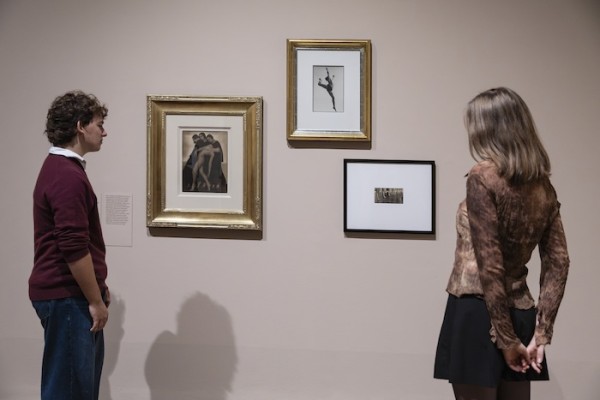
Installation view. © Copyright Tate Modern (Photo by Larina Annora Fernandes)
Originally entitled Global Pictorialism and scheduled to open at the end of 2025, Tate Modern's survey of the movement finally opened on October 14 as Light and Magic. At the outset, this promised to be a very interesting exhibition. While aiming to introduce "a largely forgotten movement in the history of photography to a wider public", the exhibition, curated by Charmaine Toh, appointed Senior Curator of Photography by TM in 2024, throws a wide net, the timeline stretching into the 1960s and covering not only Pictorialism in the US and Europe but also Japan, China, India, Singapore, South Korea, South Africa, Brazil, Egypt and other countries, and, according to the press release, it "builds on Tate Modern's ongoing commitment to rethinking traditional histories of modern art through an international lens."
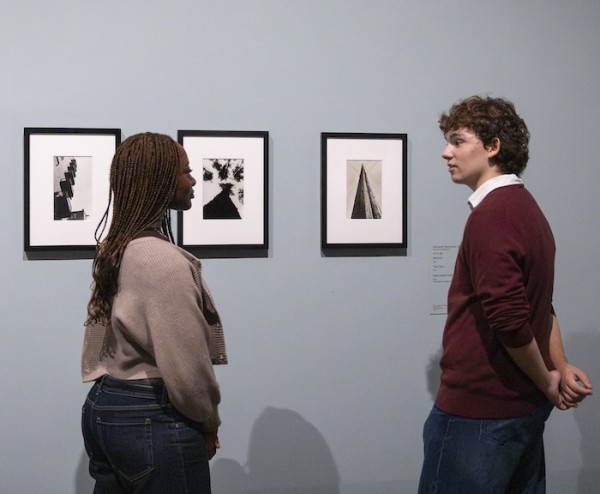
Installation view. © Copyright Tate Modern (Photo by Larina Annora Fernandes)
The works in the exhibition come from Tate's own collection, the RPS Collection at the V&A, the Wilson Center for Photography, as well as loans from other institutions, estates, and private collectors, including the collection of Sir Elton John and David Furnish. While I found the "international lens" (works made beyond the West) interesting, the selection of works chosen to explain the development in the US and Europe is very uneven and it does little to convey the true power of the movement and why it would take such a firm hold. There are works by Peter Henry Emerson, Frederick Evans, Alvin Langdon Coburn, as well as several striking masterpieces here, including the Bewegunsstudie, A Movement Study by Rudolf Koppitz, and Steichen's extraordinary portrait of Stieglitz enveloped in shadows but there are simply too few of them here. Instead of gum and platinum prints, often gravures are displayed instead. In the case of an untitled work from the cycle 'Riga Pantomime' (1964-67) by Zenta Dzividzinska, what's on show is an inkjet print made this year.
While most history books will state that Pictorialism began to fizzle out after WWI, to be replaced by modernism and/or surrealism, it remained a popular style in camera clubs, lasting well into the 1960s. The subject of late Pictorialism has been the subject of previous exhibitions and books, notably Christian A. Peterson's 1997 exhibition and book, After the Photo-Secession: American Pictorial Photography, 1910-1955, making clear that the style would often be mixed with other styles, an approach that many beyond the West also used.
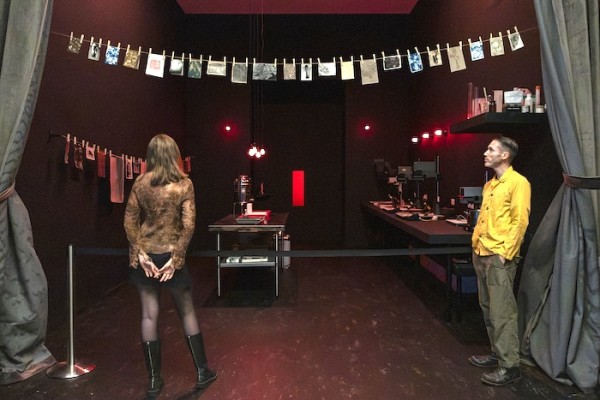
Installation view of a working darkroom. © Copyright Tate Modern (Photo by Larina Annora Fernandes)
This exhibition is interesting in parts, but it is also seriously flawed. Its full title is "Light and Magic – The Birth of Art Photography". Art photography, however, was born as soon as the medium was developed by Nicéphore Niépce, Louis Daguerre, William Henry Fox Talbot and Sir John Herschel. The press release states that "From the 1880s, Pictorialism transformed photography from a documentary tool into a fine art to establish a powerful artistic medium."
This is simply incorrect. Aesthetics were apparent in the works the aforementioned pioneers produced, as it was in the work of the best of those who began to use their processes. The big push to establish photography as an art form, and by extension, a market for fine prints, came in the early 1850s, with Gustave Le Gray and Roger Fenton leading the way for many others. As for being a documentary tool, Le Gray drew considerable criticism for his method of combining negatives to produce his striking sea views and cloud studies, spending hours and hours in order to get the right tones in his large prints. Le Gray had started as a painter, as had many others in his circle and in France.
Even though some projects were initiated for purely documentary purposes, photography deemed more exact than drawing, some photographers would turn them into art. To cite one example, this was the case when Captain Linnaeus Tripe in 1855 was charged by the Court of Directors at the East India Company to document the architecture of Burma, then made official photographer to the Madras Government in 1856, and "to record, before they disappear, buildings, sculptures and inscriptions … including the picturesque." This assignment resulted in some of the most important photographs in early British photography. Tripe spent a considerable amount of money to produce his prints, resulting in the new governor, Sir Charles Trevelyan, ordering a stop to the project in 1859.
That first push to establish photography as an art medium reached a symbolic end around 1860. Le Gray absconded to Egypt, Fenton sold his equipment at auction and returned to his profession as a lawyer. Pictorialism was therefore the second push. It would take a third push, starting at the end of the 1960s, before photography was finally accepted as an art medium, with a functioning market.
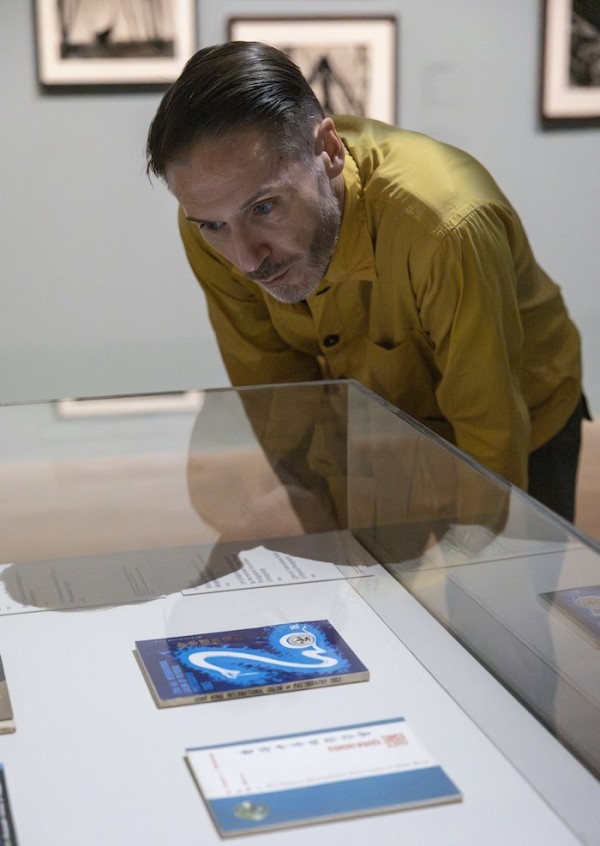
Installation view. © Copyright Tate Modern (Photo by Larina Annora Fernandes)
The exhibition starts, to make a point, I guess, not with a household name, but with a series of 1940s works by Chinese photographer Lang Jingsha, who combined negatives to create subtle prints akin to traditional Chinese ink wash paintings. I particularly liked to see the works by practitioners from beyond the West. And behind the works were many interesting stories, not least those from Southeast Asia, emerging from political turmoil and searching for new identities. But it is maddeningly difficult to trace the developments in the different territories, as the works are scattered across sections, on "dance" and other vaguer descriptions such as "local voices", "global conversations".
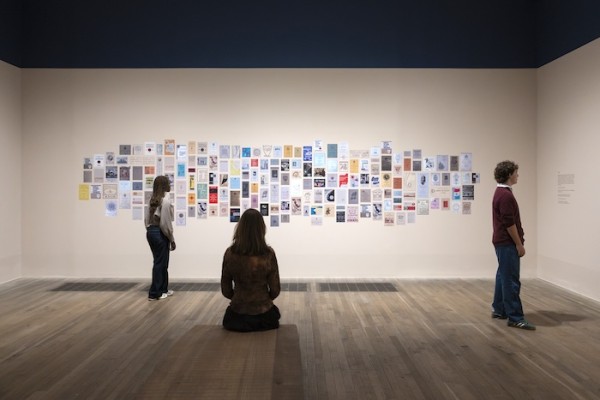
Pictorialism was an extremely well-organized movement, with camera clubs and societies sending journals and prints for exhibitions around the world. A whole wall has been plastered with facsimiles of labels attached to the backs at each stop. Much is made here of the importance of camera clubs and societies, but it also means showing a lot of not particularly interesting photographs. When they do appear, they really stand out, such as the group of photographs by Fan Ho, who was very active in the Hong Kong Photographic Society.
In addition to journals produced by the various clubs and societies, a section explains the technical aspects of the various processes used by the Pictorialists: bromoil, gum, carbro, Fresson, photogravures. etc. There's also a fully functional darkroom, where visitors can watch printers at work, or participate in workshops.
Wandering on, I came across a group of modernist studies by Alexander Rodchenko, and the famous Shell by Edward Weston, as in a posthumous Cole Weston print. The assertion here is that "Pictorialism did not end with modernism, it gave birth to it". Which is simply not the case. Early Pictorialism was mired in the zeitgeist that existed "before the storm", its worst clichés being a nostalgic vision of landscapes and women as mothers, Madonnas or temptresses. And then the world changed with WWI. There were new movements in art (cubism and futurism having started well ahead of the outbreak), and graphic design, new technologies, cinema, picture magazines, changing socioeconomic conditions and the questioning of gender roles. All of which influenced modernist photography.
Installation view. © Copyright Tate Modern (Photo by Larina Annora Fernandes)
Among the Rodchenko prints is Balconies, taken in 1925. That same year, he took a photograph of Regina Lemberg with a Leica camera, attached to a tripod, her peering through the viewfinder. She is not portrayed as a mother, madonna or temptress, but as a modern woman. That Rodchenko sometimes "exhibited in salons" does not make him a Pictorialist. It is also strange to see work here by Iwata Nakayama, the Japanese avant-garde artist, maker of photograms and montages.
The criterion for being a Pictorialist here seems to be doing "something creative with a camera and/or in the darkroom" but that happened long before Pictorialism, as a specific movement, emerged. Alfred Stieglitz recognized the lines to those who had gone before. In Camera Work October 1905, he announced the plans that he and Steichen had for the Photo-Secession's gallery in New York, "It had been planned by the Photo-Secession to hold in New York, early next spring, an exhibition, consisting of the very best that has been accomplished by Pictorial photography, from the time of (pioneering Scottish photographer David Octavius) Hill up to date, in various countries."
Stieglitz published not only work by Hill and Adamson in Camera Work but also by Julia Margaret Cameron. That photographers would stretch the possibilities from the word go, is hardly surprising. New technologies have always attracted artists, resulting in early computer art, Xerox art or the fax art by David Hockney and Will Larsen. True, Weston, as well as Paul Strand, Imogen Cunningham, Ansel Adams did start out as Pictorialists, but they broke with Pictorialism, to embark on straight photography, as did Stieglitz. An approach they explored with the same passion as they had Pictorialism, but the inspiration would largely come from somewhere else. Weston famously had a debate in print with William Mortensen over the value to photography from Pictorialism. Weston had quite viciously rejected the premises of Pictorialism in favor of "straight" photography.
The exhibition continues until February 2027.
Michael Diemar is editor-in-chief of The Classic, a print and digital magazine about classic photography. In August 2025, he cofounded Vintage Photo Fairs Europe, an organization focused on promoting independent tabletop fairs in Europe and spreading knowledge about classic photography in general. He is a long-time writer about the photography scene, writing extensively for several Scandinavian photography publications, as well as for the E-Photo Newsletter and I Photo Central.
Paris Tabletop Photo Fair Opens Only on Saturday, Nov. 14th at the Pavillon Wagram with 60 International Dealers Focusing on Vintage Photography
Exhibit Review: Light and Magic at Tate Modern
Chrysler Museum of Art Announces $2 Million Endowment for New Curator of Photography
AIPAD Announces Dates and Location of Its 2027 "Photography Show"


Share This