

MIA Photo Fair BNP Faribas: Milan’s Photo Fair Undergoes Metamorphosis
Interview: Ettore Molinario, Italian Collector with a Live-in Museum
Interview: Vladimír Birgus, Czech Photographer and Photohistorian
Noted 19th-century Photo Dealer and Expert Robert Hershkowitz Passes away
Make an Appointment with Us during AIPAD
Met Museum of Art Appoints Oluremi C. Onabanjo as Photography Curator
Book Review: PAPER PRINTERS PRINTING – Photographs from the Collection of Barry Singer
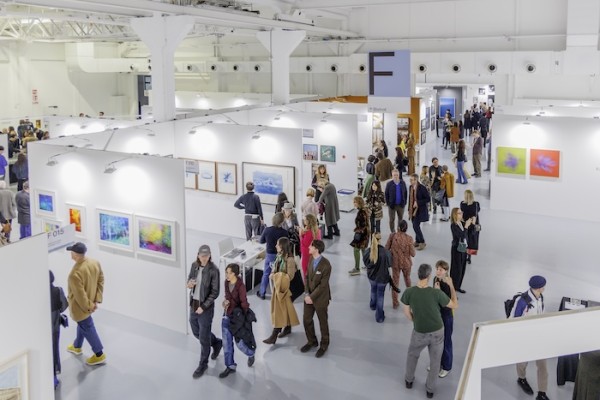
Overview of the 2026 MIA Photo Fair in Milan. (Photo by Zima Studio)
2026 marked the 15th edition of MIA Photo Fair BNP Paribas, Italy's leading photography fair. It was founded in 2011 as a fair for contemporary photography and was in the following years, according to people I spoke to, of very uneven quality. Three years ago, Francesca Malgara took over as director. She has not only increased the standard significantly. There is also more vintage photography on offer. The theme of this year's edition was, appropriately, Metamorphosis.
The fair hosted 111 exhibitors, including 76 galleries, of which 27 were international, some of which exhibit at Paris Photo, including Esther Woerdehoff, Paris, Willas Contemporary, Stockholm, Galerie Springer, Berlin and Galeria Alta, Andorra. Among the Italian galleries were Cartacea, Bergamo, and Enrico Abrate told me, "Italy still lags behind countries with a long established collecting tradition, such as France and the United States but significant private collectors and institutions, such as Gallerie d'Italia, CAMERA, and MAST are playing a crucial role in fostering the growth and recognition of photography in Italy. At the same time, a younger generation of collectors is emerging, encouraged, in part, by photography fairs and photo festivals across Europe, with interests spanning both the great masters of 20th-century photography and contemporary research."
For the art trade as a whole, Italy has become a whole lot more attractive since the Italian government's decision in June 2025 to slash Value Added Tax on art from 22%, the highest in Europe, to 5%, now the lowest in the EU, in order to, as Italy's Minister of Culture Alessandro Giuli put it, "end the perception of the country as a cultural desert and transform Italy into a global art hub".
This was the first time I attended the fair. I was invited to moderate the first of three conversations, "The Metamorphosis of Collecting–Past, Present and Future", curated by Ettore Molinario Collection, discussing the formation of the modern photography market with Anette Kicken of Kicken Berlin and Howard Greenberg of Howard Greenberg Gallery, New York. Later on, I interviewed Ettore Molinario.
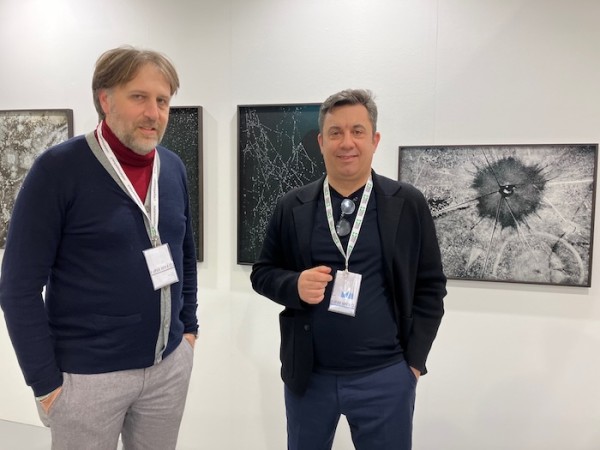
Marco Citron and Enrico Abrate, Cartacea. (Photo by Michael Diemar)
Many exhibitors had drawn inspiration from the theme of Metamorphosis, including the aforementioned Cartacea, Bergamo. The presentation was first-rate. Enrico Abrate told me, "We wanted to reflect a theme of transformation, whether in identity, form, or perception. All three artists explore these themes in distinct ways. Joan Fontcuberta plays with transformation by crafting fictional narratives from his archive and challenging the boundaries between reality and imagination. Charles Freger approaches transformation through an anthropological lens, using portraiture to investigate contemporary ceremonial costumes and rituals in India, and Giulia Parlato explores temporal transformation, revealing the stratification of time and the accumulation of dust on statues preserved in the deposits of the Accademia di Brera in Milan."
Reactions had been good, "Visitors were curious and deeply engaged, drawn not only by the visual appeal of the works but also by the presence of Joan Fontcuberta himself, who gave a talk and conducted a book signing. Many were fascinated by his unique approach, where he blurs the line between fiction and reality. And I'm pleased to report that we achieved strong sales, primarily with new clients, including several international buyers. Additionally, we have expanded our institutional presence, with a US museum acquiring a work by a young contemporary artist."
Abrate has exhibited at the fair before and thinks it's moving in the right direction. "The improvements are tangible compared to past editions. There's a clear effort to enhance the organization, and the selection of galleries and artists is becoming increasingly appealing each year. However, one area that still stands out is buyer behavior, as many visitors remain somewhat indecisive. Providing additional guided tours, artist talks, or curated recommendations could help buyers make decisions more confidently and ultimately foster a more dynamic and engaging marketplace. Looking ahead, bringing in more international buyers represents the next major challenge for the fair, as expanding its reach would further elevate its profile and create new opportunities for both artists and galleries."
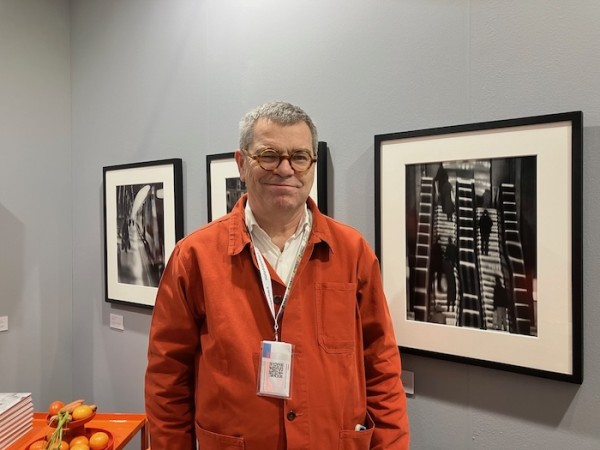
Alberto Damian (Photo by Michael Diemar)
The presentation of Alberto Damian Gallery, Treviso, another exhibitor at Paris Photo, received high praise from just about everyone I talked to. Damian had also taken his cue from the fair's theme. He told me, "I started with the concept that every photograph is a metamorphosis because a white sheet of paper becomes something different thanks to the action and the vision of the photographer. The "fastest" metamorphosis was given by the Polaroids, which were "ready to be seen" in 30 to 90 seconds, depending on the temperature of the air".
I was very impressed by the Polaroids, taken by Euro Rotelli, of bodies, hands feet of dancers, some exhibited with their sheets. Franco Donaggio was included with a series of images taken at the Central Station in Milan in 1996. Donaggio had then projected the images on white, moving sheets, distorting the images, and then photographed them. Damian was also showing color works by Alain Fleischer, made in 1970 by projecting slides on the bodies of the models, then photographing them. There were also works Paolo Gioli and Nicoletta Deva Tortone, and the latter had made some incredible mosaics of the human body with tiny, tiny photographs.
It was one of the best presentations at the fair but Daman told me, "We had positive reactions to the booth but sadly, this did not translate into good sales. There was a lack of collectors with spending power. I think that the level of the fair has improved, but there are still too many "decoration pieces" rather than "artistic pieces" for real collectors."
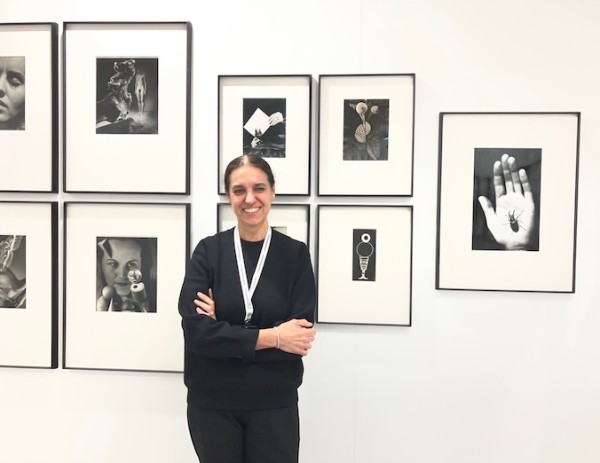
Laura Leonelli (Photo by Michael Diemar)
Far, far better results were reported by Laura Leonelli Gallery, Bergamo, and there was a metamorphosis going on in her booth, as an ever-changing display, as sold works had to be replaced with new ones. It was a great presentation, mixing names like Brassaï, Martha Kuhn Weber and Emil Zola with anonymous photographers, and it was done with great imagination and skill.
Leonelli told me, "I have been doing personal research into anonymous and vintage photography for many years. Last year I took part in the MIA Photo Fair with a leading Milanese gallery, presenting part of my collection, featuring anonymous and lesser-known photographers, and the public response was positive. This year I decided to launch my own online gallery and exhibit independently at the fair. I have tried to present works that are consistent with the theme of 'Metamorphosis', chosen by Francesca Malgara for this edition of MIA. It is a theme that resonates deeply with me. I move amongst images and artists that have a surrealist echo and this helped me in the editing of the images. I have taken great care over the stand, keeping it simple yet elegant in the choice of frames and furnishings."
The prices of the works ranged from 1000 euros to 3000 euros, and business was brisk. Leonelli commented, "Sales have far exceeded my expectations. Visitors found my presentation quite different from the other booths, even though they also featured vintage photography. They were drawn by the quality of the images, their uniqueness, the eclectic mix and the affordable prices. I liked the fair overall. I have been following the MIA Photo Fair over the years, and I can confirm that Francesca Malgara's work, characterized by extraordinary quality and tenacity, is paying off. The MIA is an Italian fair–very warm and friendly–which is increasingly attracting the attention of foreign galleries and collectors."
Next year's edition will take place March 18-21, with a preview on March 17.
Michael Diemar is editor-in-chief of The Classic, a print and digital magazine about classic photography. In August 2025, he cofounded Vintage Photo Fairs Europe, an organization focused on promoting independent tabletop fairs in Europe and spreading knowledge about classic photography in general. He is a long-time writer about the photography scene, writing extensively for several Scandinavian photography publications, as well as for the E-Photo Newsletter and I Photo Central.
MIA Photo Fair BNP Faribas: Milan’s Photo Fair Undergoes Metamorphosis
Interview: Ettore Molinario, Italian Collector with a Live-in Museum
Interview: Vladimír Birgus, Czech Photographer and Photohistorian
Noted 19th-century Photo Dealer and Expert Robert Hershkowitz Passes away
Make an Appointment with Us during AIPAD
Met Museum of Art Appoints Oluremi C. Onabanjo as Photography Curator
Book Review: PAPER PRINTERS PRINTING – Photographs from the Collection of Barry Singer


Share This